The Universal Church: Honoring migrants and refugees in the Body of Christ
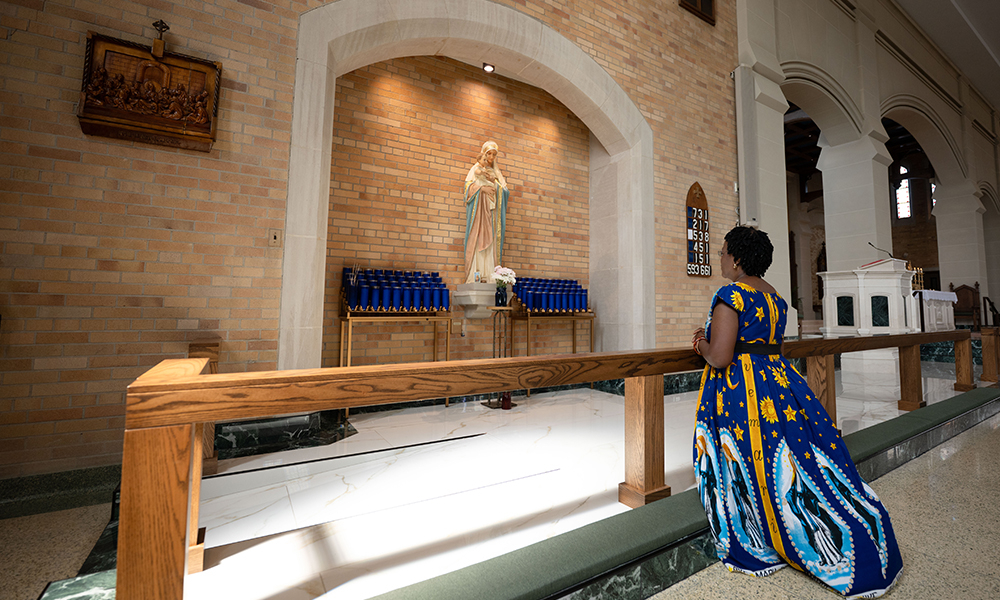
Pope Leo XIV designated Sunday, September 27, 2026, as the 2026 World Day of Migrants and Refugees while the U.S. bishops mark the week leading up to the World Day of Migrants and Refugees for focused parish activities, prayer services, and community outreach. The Church seeks to honor the stories of those who have fled their countries for safety, opportunity, and peace. Former refugee Alphonsine Busabusa of Lansing escaped violence and destitution for a better life, all while keeping her faith in Jesus Christ, the foundation of her life.
Pope Leo XIV designated Sunday, September 27, 2026, as the 2026 World Day of Migrants and Refugees while the U.S. bishops mark the week leading up to the World Day of Migrants and Refugees for focused parish activities, prayer services, and community outreach. The Church seeks to honor the stories of those who have fled their countries for safety, opportunity, and peace. Former refugee Alphonsine Busabusa of Lansing escaped violence and destitution for a better life, all while keeping her faith in Jesus Christ, the foundation of her life.
“I packed a small bag with a change of clothes, a rosary, a prayer book, and a little bit of sugar. This was all that I could bring, because I had to carry my baby.” Thus began Alphonsine Busabusa’s ten-year sojourn as a refugee, across four countries, before coming finally to the United States. Alphonsine and her husband, Balthazar Matakara, fled their native Burundi in 1994 when Alphonsine’s mother was killed in the Burundian Civil War. The couple fled with their one-year-old son to Zaire (now the DRC).
Their second child was born there but died from lack of access to medical care as a result of the spreading conflict. As the war escalated, Zaire proved no safer than Burundi, so the family was forced to flee again, this time to Tanzania. In Tanzania they had to stay in one of the refugee camps for the hundreds of thousands of Burundians and Rwandans fleeing genocide. Alphonsine’s third child was born in the camp. After several years there, they moved onto Zambia, where their fourth child was born. Finally, in 2004, they were relocated to the United States and quickly made a home in Lansing.
“The only thing that kept us going through all those years was prayer and our faith in God,” Alphonsine recounts. “When you have nothing, you know that if you are going to survive it is going to be because of the miracles of God.” When fleeing from Zaire to Tanzania, the family had to cross Lake Tanganyika, whose choppy waters sometimes sank boats overloaded with refugees. Their boat made several attempts and had to turn back each time because it took on too much water. “We prayed for God to make way. The next morning the water was perfectly calm. I consider that a miracle.”
“We prayed for God to make way. The next morning the water was perfectly calm. I consider that a miracle.”
In each new country, the first question Alphonsine would ask was, “Where is the church?” And then she would find other believers to pray with. “In the Tanzanian camp, there was no church. And so, the first thing we did was build one.” Then they petitioned the UN workers to get them a priest so that they could celebrate the Mass. “The great thing about the Catholic Church is that it's universal. In each new place, the Mass might be prayed in another language, but because it's the same Mass, you can still follow along.”
God continued to answer her prayers after they arrived in Lansing. She knew that she wanted her children to attend Catholic schools but was unsure she could afford tuition. She found that Resurrection School welcomed them with open arms and members of the parish made sure that her kids had uniforms and helped with transportation.
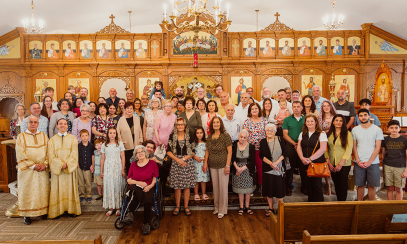
But when Alphonsine began working for Catholic Charities Refugee Services, she learned that not all refugees were finding it so easy to enter parish life in their new homeland. In fact, she discovered many were attending Protestant churches that offered worship services in African languages. So she helped to start a small group that would read the weekly Mass readings and explain the homily in African languages. This group, which came to be known as the African Catholic Community of Lansing, began to reach out to other African Catholics by bringing meals to families with newborns, visiting the sick, arranging funerals, and organizing transportation to Mass. “We wanted to show people that they are not alone, that they need the Catholic Church and the Church needs them.”
Eventually the community asked the bishop for a priest who could say the Mass in their native languages, and an existing annual Mass to pray for peace in Africa became a monthly Mass at St. Thomas Aquinas celebrated in a combination of Swahili, Kirundi, Kinyarwanda, and French and featuring a choir singing African music.
Alphonsine continues to work hard to make sure that refugee children who attend public schools are still receiving their sacraments and encourages refugee families to get involved in their parishes as quickly as possible. “I realized at some point that God is using me to do the same work here that I was doing in each country along the way: connecting people to each other to build up the Body of Christ.”
Holy Mass for the African community is celebrated the first Sunday of each month at 3:30 p.m. at St. Thomas Aquinas Parish in East Lansing. More information about Catholic Charities in the Diocese of Lansing can be found at www.dioceseoflansing.org/catholic-charities.