Memento Mori: Monsignor Lunsford’s Reflections Upon the Four Last Things
“Have you seen the dead leaves fall in the sad autumn twilight? Thus, souls fall each day into eternity. One day, the falling leaf will be you.”
— St. Josemaría Escrivá (1902-75)
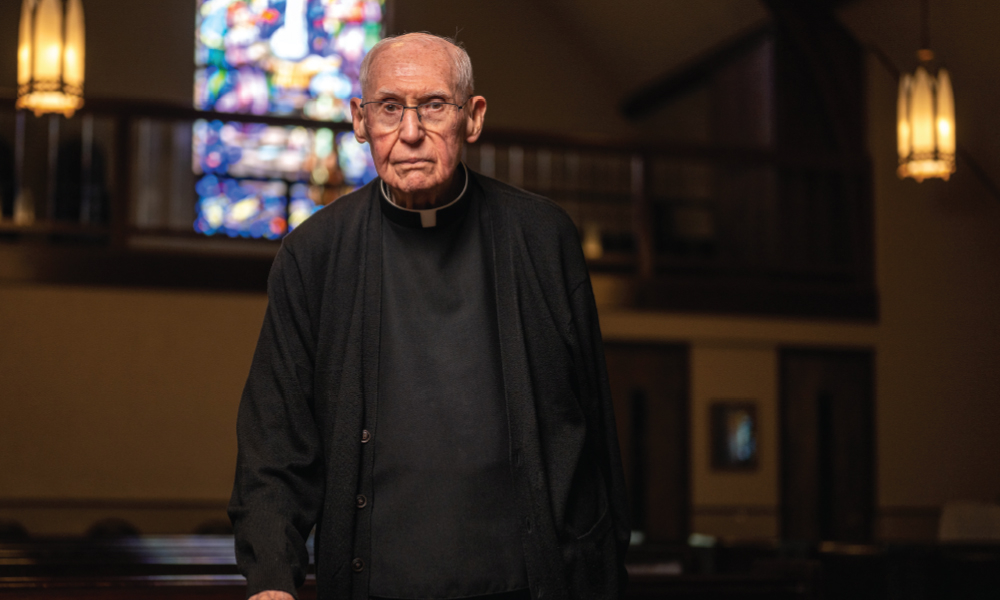
November is the Month of the Holy Souls. It is a time to prayerfully ponder our own mortality and the fourfold reality awaiting each of us: death, judgment, heaven, or hell. FAITH asked Monsignor Robert D. Lunsford to pen a meditation upon these four last things. The 92-year-old Monsignor Lunsford was ordained to the sacred priesthood in 1960. A former chancellor of the Diocese of Lansing, he retired from active ministry in 2005.
Monsignor writes: We make a Profession of Faith each Sunday. It concludes "I look forward to the resurrection of the dead and the life of the world to come." or, as the Apostles Creed states, "I believe in the communion of saints, the forgiveness of sins, the resurrection of the body and life everlasting." Who among us has not mourned the loss of a relative or friend, shedding tears and praying for the happy repose of their souls. Jesus wept at the death of his friend Lazarus and had compassion for the widow of Nain, restoring her son to life. We are reminded daily of the fragility of life and the certainty of death, not only others' but our own.
And so, as we approach the end of the liturgical year, the Church invites us to contemplate the final things — our deaths, the judgment that follows, and its consequence, heaven or hell. We do so as we commemorate the Feasts of All Saints and All Souls on Nov. 1 and 2. As members of a great family, the communion of saints, we are one with all who have gone before us sealed with the sign of faith — the saints in heaven and the souls in purgatory. God says "Be holy, for I your God am holy." Leon Bloy, a French novelist, ends his novel The Woman Who Was Poor with the words "There is only one tragedy in life, not to be a saint." Nothing could be more true.
In the end there will be heaven and hell, eternal bliss or endless suffering. We will be, in the words of C.S. Lewis "immortal glories or immortal horrors." Heaven is life with God, happiness and bliss beyond imagining — love, life, light, peace, harmony, wholeness. "Eye has not seen, ear has not heard, nor has it so much as dawned on man what God has prepared for those who love him." (1 Cor 2:9) Hell is darkness, isolation, hatred, separation, endless fire and pain; above all, separation from God who made us for Himself and loves us, calling us by name, in Whom alone our hearts will find rest. Dante rightly inscribes the portal of hell "Abandon hope, all you who enter here."
We make many choices daily, most insignificant, but ultimately each is either one we address to God saying, "Thy will be done" or, "my will be done." The theme song of hell surely is "I did it my way." God created us in His image, with the ability "to know'' and the "freedom to choose." Choices have consequences. Our loving Father, "plentiful in mercy" is also a just judge.
Michel Quoist, a French priest, wrote a book of prayers, one of which was entitled "There Are Two Loves Only" followed by the words, "either the selfless love of God and others or the selfish love of self." Every choice we make in life is one or the other. In the end we become the choices we make and will be judged on them. This occurs at the moment of death. "Just as it is appointed that men die once, and after death be judged, so Christ was offered up once to take away the sins of many; he will appear a second time not to take away sin but to bring salvation to those who eagerly await him." (Heb 9;27) St. John of the Cross observes "At the end of life we will be judged on love." The second judgment occurs at the end of time for the entire human race and confirms the first. We will rejoice in the mercies of the Lord and give thanks for the saving grace of Our Lord's suffering and death, which has overcome all sin and destroyed death.
That leaves purgatory. Maccabees 12:43-46 records a collection taken up to offer sacrifice for soldiers killed in battle. It reads "it was a holy and pious thought. Thus he made atonement for the dead that they might be freed from their sin." To enter heaven we must be perfected in love. Most of us do not reach that state in life, and when we die in God's love but not entirely free from sin or its residue, we need purification. It is described as a refining fire, perfecting our charity. This is where the communion of saints is such a consolation. Our prayers for the souls in purgatory can hasten their purification and entrance into heaven. And the prayers of the saints in heaven and souls in purgatory help us to grow in charity. They are our sisters and brothers in Christ.
"O death where is your victory? O death where is your sting? But thanks be to God, who gives us the victory through our Lord Jesus Christ." (1 Cor. 15:55-56)