A Golden Flame in Lansing
Celebrating 50 Years of St. Joseph Melkite Parish - The Beauty and History of the Byzantine Rite in Lansing
Celebrating 50 Years of St. Joseph Melkite Parish - The Beauty and History of the Byzantine Rite in Lansing
October marks the 50th anniversary of St. Joseph the Betrothed Melkite Greek-Catholic parish in Lansing. St. Joseph is one of only six Eastern Catholic parishes within the Diocese of Lansing. The anniversary marks 50 years since St. Joseph was established as a mission, but the story of Lansing’s Melkite Catholics reaches back more than a century.
October marks the 50th anniversary of St. Joseph the Betrothed Melkite Greek-Catholic parish in Lansing. St. Joseph is one of only six Eastern Catholic parishes within the Diocese of Lansing. The anniversary marks 50 years since St. Joseph was established as a mission, but the story of Lansing’s Melkite Catholics reaches back more than a century.
Melkites are Byzantine Catholics whose historic roots lie primarily in the Middle East. St. Joseph parishioners originally came largely from Lebanon and Palestine, with Syrian and Iraqi families also helping to make up the parish community.
The word “Melkite” comes from a Semitic word meaning “royal” or “of the king” and has its roots in the theological controversies of the early Church. Today, the Melkite Greek Catholic Church is one of the 23 Eastern Catholic Churches in full communion with Rome. It is headed by Patriarch Joseph Absi, whose patriarchal see is in Damascus, Syria.
Although St. Joseph was founded in 1976, Melkite Catholics had been in Lansing for decades. By 1910, a substantial community of Middle Eastern Catholics was worshiping at what is now St. Mary Cathedral. That year, Lansing’s Syrian American Association petitioned the Most Rev. John Foley, then Bishop of Detroit, asking that a Melkite parish be established for the community. The letter bears the signatures of more than 100 men, representing families whose wives and children would also have formed part of the proposed parish.
A priest had even been brought from Egypt, and Father John Rafferty, pastor of St. Mary, sent at least three letters to Detroit describing the situation. For reasons that are no longer known, the request was not granted.
Beginning in the mid-1960s, a Melkite Catholic hierarchy was established in the United States, bringing together Melkite parishes that until then had been under the jurisdiction of local Roman Catholic dioceses. The establishment of new Melkite parishes consequently became much more streamlined. In the mid-1970s, an eparchy — the Eastern Catholic equivalent of a diocese — was formally established for Melkites in the United States, and in 1976, St. Joseph was established. The community first met at the former St. Vincent’s Home on Lansing’s west side, through the gracious permission of the late Bishop Kenneth Povish.
In 1981, the community used the remaining assets of the dissolved Syrian American Association to purchase a building in Potterville, which remained its home for the better part of a decade.
Through the hard work of St. Joseph’s Ladies Society and the rest of the community, St. Joseph continued to grow and thrive. In 1982, it was canonically erected as a parish.
In 1989, the parish purchased property at the corner of Mt. Hope Avenue and Rundle Street. The property included a church and small rectory. A few years later, the house was demolished to provide additional parking for the growing parish community, and a rectory was purchased in Delta Township.
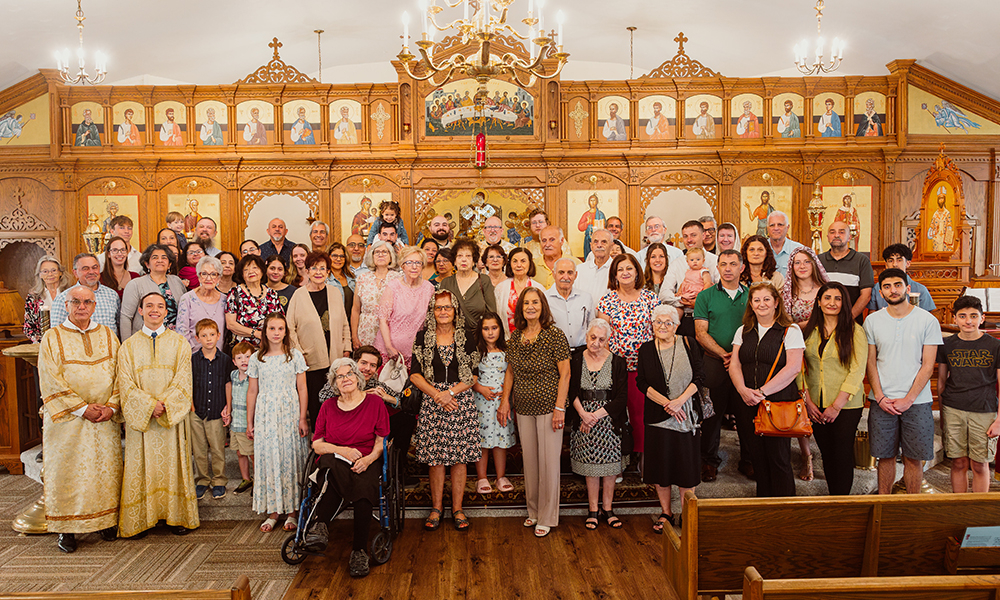
Since that time, parishioners, led by successive pastors, have transformed the interior of a relatively generic church building into a beautiful traditional Byzantine worship space.
Behind its nondescript brick exterior, visitors encounter icons of Christ; Mary, the Theotokos; the Apostles; and many other saints, including several with particular importance to parish families, such as St. Mammas and St. Victor.
The late Louis Kuri handcrafted the imposing wooden icon screen, altars, bishop’s throne, lecterns, and wainscoting. Hanging lamps flicker before the icons, their flames reflecting from golden altar furnishings and helping to convey the beauty and glory of God.
The people who worship there reflect more than a century of Middle Eastern immigration to the United States. Several waves of immigration from the Holy Land and surrounding regions have contributed to the growth of St. Joseph Church. Whether fleeing persecution under the Ottoman Empire, the dangers of the Lebanese Civil War, or the continuing strife of the Israeli-Palestinian conflict, families have come to America seeking refuge and a new life.
Some St. Joseph parishioners are recent immigrants; others are third- or fourth-generation Americans. Intermarriage, spiritual seeking, and even simple curiosity have also brought Catholics without Middle Eastern ancestry into the parish community.
On Sundays, St. Joseph Church celebrates the Divine Liturgy of St. John Chrysostom, the ancient Byzantine liturgy also celebrated in Orthodox churches throughout the world. Any Catholic may worship at St. Joseph and receive the sacraments, and visitors are warmly welcomed. The Divine Liturgy is celebrated primarily in English, with some prayers and hymns in Arabic or Greek. The services are sung, led by cantors, without instrumental accompaniment.
For holy Communion, the faithful receive the consecrated bread together with the consecrated wine, administered from the chalice.
St. Joseph has also become well known throughout the Lansing area for its annual food festival, featuring traditional Middle Eastern foods and sweets.
This October, however, the parish will celebrate something even richer than its food and traditions: 50 years of a community formally established in 1976, built upon the faith of Melkite Catholics who had already made their home in Lansing generations earlier.
From the families who petitioned for a parish in 1910, to those who established the mission in 1976, to the parishioners who worship beneath the icons at St. Joseph today, each generation has helped preserve and pass on an ancient Catholic faith in a new home.
As St. Joseph the Betrothed celebrates its first 50 years, its parishioners give thanks for those who built the community — and look with hope toward the generations who will carry it forward.