The Road to Emmaus
Fritz von Uhde
(1848 – 1911)
Fritz von Uhde
(1848 – 1911)
Fritz von Uhde was a German painter at the end of the 19th century, a time of great artistic transition. He helped found the Munich Secession, a cooperative formed in 1892 to protect innovation in the face of government-supported conservatism in art. As a young man, out of frustration with the state-imposed limitations, he abandoned his artistic studies. After a decade in the army, he returned to his true vocational battlefield: the canvas. Uhde pursued a style that blended realism and impressionism, which he applied to scenes of simple daily life. A committed Lutheran, Uhde infused his work with an evangelical spirit that similarly broke with convention. Bringing Christ into everyday scenes, Uhde depicts a familiar and approachable savior.
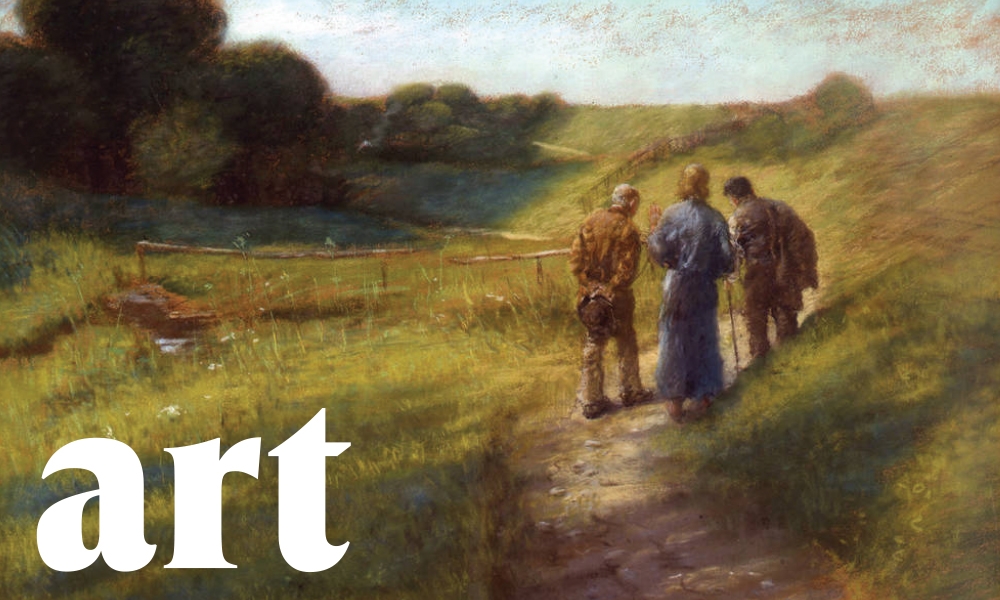
Der Gang nach Emmaus (1891), The Road to Emmaus, is executed in pastel on paper, likely en plein air, as Uhde is widely credited with introducing outdoor painting to Germany. The disciples incline their heads towards Christ’s illuminating words, the gait unhurried and contemplative. The Gospels tell us that this enlightenment was followed by wonder and haste once Christ made himself known. But the artist focuses on this transitional moment for Christians: after the Crucifixion but before each has had his faith in the Resurrection confirmed. He asks the viewer to ponder Christ’s gentleness.
Of his work, Uhde remarked, “many of the French artists wished to find the light in Nature. I wished to find the light within the figure that I was presenting. In Christ I grasped the embodiment of the outward and the inward light.” Uhde paints to express, like the men after supper at Emmaus did, “I too have seen the risen Christ!”