St. Christopher woodcut by Albrecht Dürer
Albrecht Dürer had a talent that still resonates 555 years after his birth, and his art immerses us in the realities of late-15th-century Europe, which are still relevant to the Christian today. The son of a goldsmith and godson of Germany’s most successful publisher, Dürer applied both of their crafts to his own art, producing hundreds of meticulous woodcuts and engravings, prints of which carried his art throughout Europe and the Mediterranean during the Northern Renaissance.
Albrecht Dürer had a talent that still resonates 555 years after his birth, and his art immerses us in the realities of late-15th-century Europe, which are still relevant to the Christian today. The son of a goldsmith and godson of Germany’s most successful publisher, Dürer applied both of their crafts to his own art, producing hundreds of meticulous woodcuts and engravings, prints of which carried his art throughout Europe and the Mediterranean during the Northern Renaissance.
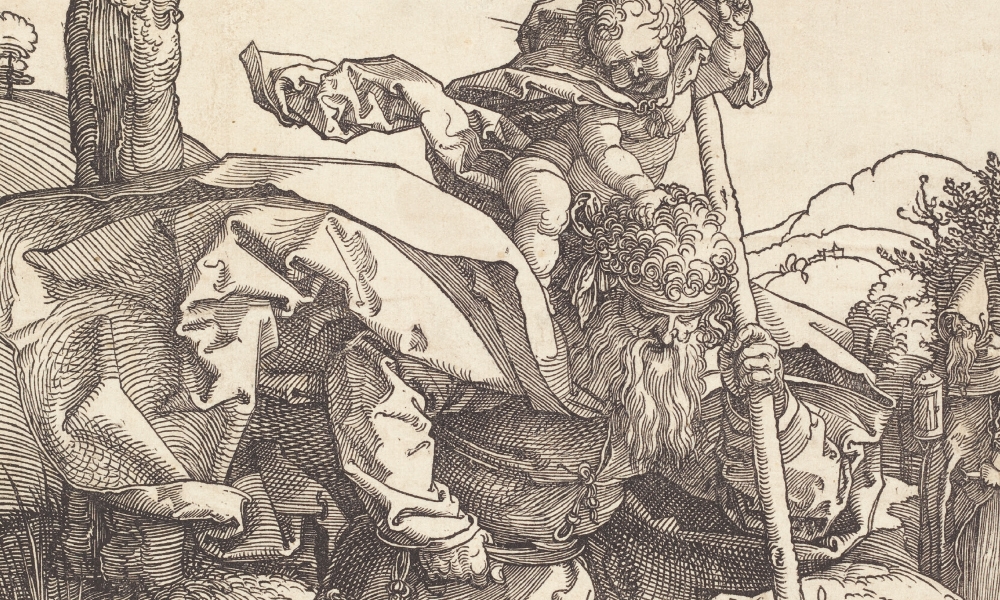
This woodcut print of St. Christopher measures just 8.5 square inches, yet it is full of movement and detail. The balanced composition and mastery of anatomy recall Dürer’s Italian contemporaries, but the hermit with the Steinkrug in the corner is a nod to his native Bavaria. The scene depicts the legend that this Herculean figure, newly converted to the faith, met the Christ child in his work of ferrying travelers across a river. As he carried this child, the weight became oppressive. Christ explained that he, the maker of the world, carried its weight on his own shoulders. The saint received both his name, “Christ-bearer,” and wisdom in the school of the cross: it is Christ who bears each burden, and we have only to live out our vocation in humility and obedience to please the greatest master. Dürer mirrors the passion scenes depicted in his prolific works here in Christopher and in his own faithfulness to his gifts, reminding us, down the centuries, that each day provides the opportunity to sanctify both work and suffering.