The third document of Vatican II Dei Verbum
Pope Paul VI promulgated Dei Verbum (The Dogmatic Constitution on Divine Revelation) on Nov. 18, 1965. It is one of the four principal constitutions of the Second Vatican Council. Despite being one of the Council’s shortest documents at just under 6,000 words, it reshaped Catholic theology by reframing the Church’s understanding of divine revelation, the Bible and Sacred Tradition. Rather than choosing between traditional apologetics and modernizing ruptures with the past, Dei Verbum resolved long-standing post-Reformation debates by harmonizing modern critical needs with Magisterial authority. In doing so, the Council placed Sacred Scripture back at the center of ecclesial life.
The vision
Prior to the Second Vatican Council, Catholic theology at times emphasized divine revelation as a collection of static, propositional truths or dogmatic formulas handed down by the Church. Dei Verbum shifted this paradigm without discarding past dogmas, presenting revelation fundamentally as God’s dynamic self-communication in love.
Drawing on the First Letter of John (1:2–3), the document articulates that God speaks to humanity “as friends” to invite them into divine communion. (2)
Rather than separating words from historical events, it teaches that God reveals himself through an intrinsic unity of “deeds and words.” (2)
Jesus Christ is not merely a heavenly messenger, but is the mediator and fullness of all revelation – the Word made flesh who completes God’s saving work. (4)
The key reforms
For centuries following the Counter-Reformation, Catholic theology had frequently spoken of two sources of revelation: Sacred Scripture and Sacred Tradition. This had the effect of creating a sense that these two sources were separate and independent from one another. Dei Verbum clarified that Scripture and Tradition in fact flow from the same divine wellspring, forming a single sacred deposit of the Word of God (9). Further, the constitution describes Sacred Tradition as a living reality that grows and deepens through the Holy Spirit across generations rather than being a static archive.
Dei Verbum also built on Pope Pius XII’s 1943 encyclical Divino Afflante Spiritu. Namely, it endorsed using modern historical-critical methods to discern the human intentions of the sacred authors and literary genres. (12) At the same time, it balanced this “modern” approach by affirming the biblical texts must be read within the “living Tradition of the whole Church” and in harmony with the analogy of faith. (12) This meant individual passages must be understood in the context of the Church’s entire body of faith.
Finally, Dei Verbum affirmed that Scripture teaches faithfully and without error that truth which God intended “for the sake of salvation.” (11) In this way, it steered clear of both secular skepticism and fundamentalist literalism.
The lasting impact
Dei Verbum insisted that the study of the Bible be the “soul of sacred theology.” (24)
With its encouragement of vernacular translations of Scripture, Dei Verbum revitalized Catholic preaching, parish Bible studies, and the Liturgy of the Word. This, perhaps, has been the constitution’s greatest impact on the daily life of the Church. In addition, by placing the Bible at the center of Catholic faith and grounding Catholic identity in Scripture and Tradition, Dei Verbum opened new channels for dialogue with Protestants and Orthodox Christians.
Pope Leo XIV delivered his catechesis on Dei Verbum during his Wednesday audiences between Jan. 14 and Feb. 11, 2026. In his final reflection on the topic, he identifies the purpose of Scripture: “to make Christ known and to open dialogue with God.” Consequently, the ultimate purpose of reading and meditating on the Scriptures is “to get to know Christ and, through him, to enter into a relationship with God, a relationship that can be understood as a conversation, a dialogue.” This occurs, he said, when we read the Bible with an “inner attitude of prayer.”
Did You Know?
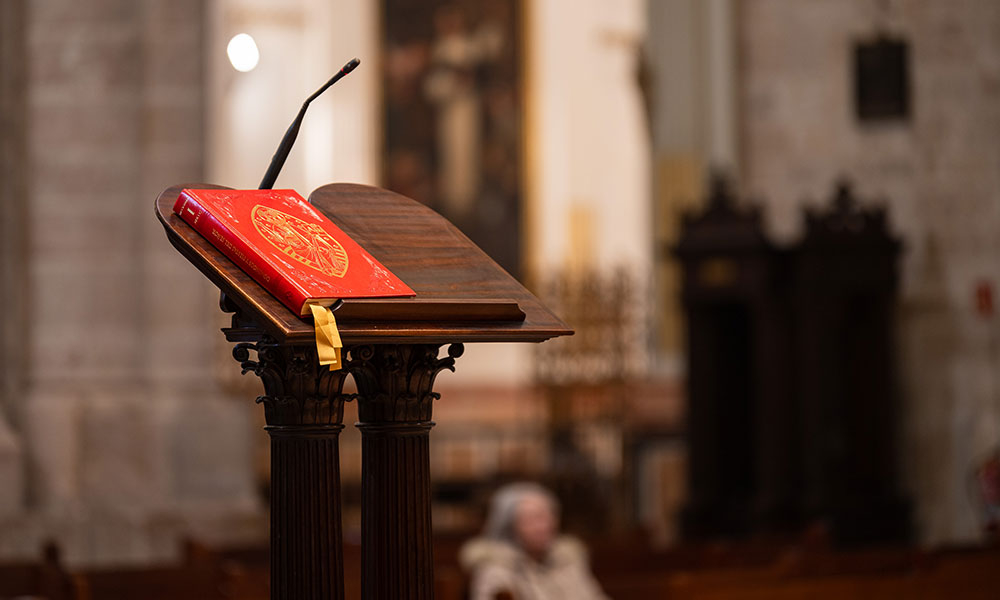
From A Concise Guide to the Documents of Vatican II: “Each day of the Council, before debate began, the book of the Gospels was solemnly enthroned in a place of prominence near the altar of St. Peter’s. This gesture emphasized the importance of Scripture at Vatican II, for the word of God symbolically presided over the proceedings.” (Hahnenberg, 30)
Doug Culp is the chief operating officer for the Pontifical Mission Societies of the United States.