Teaching the whole person
When Father Gabriel Richard High School’s (FGR) leaders say Christ is at the center of everything the school does, they aren’t kidding.
When Father Gabriel Richard High School’s (FGR) leaders say Christ is at the center of everything the school does, they aren’t kidding.
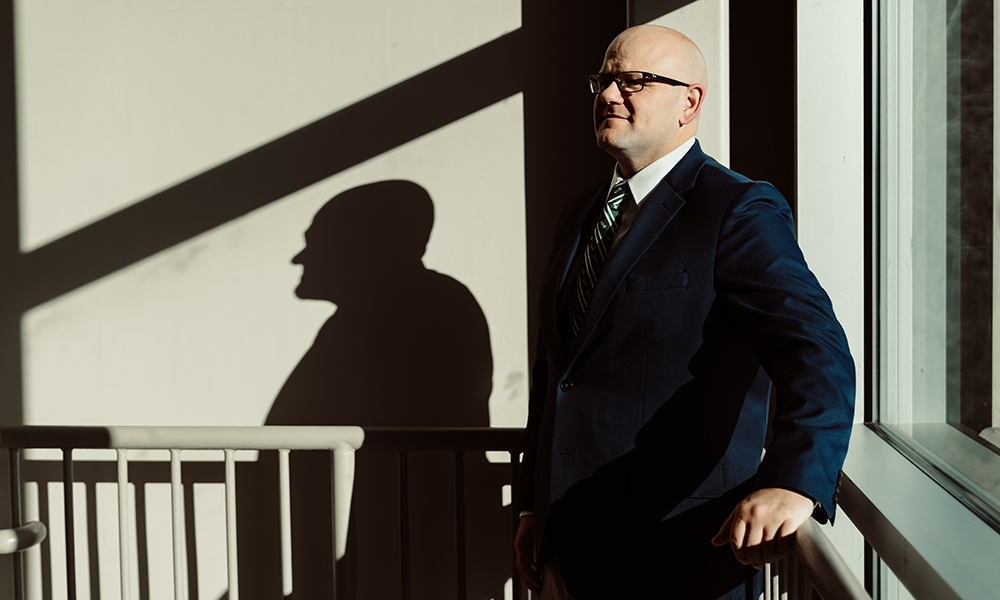
“The chapel is in the center of the building,” says Principal Christopher Dotson. “We have the sacraments readily available, and we’re teaching from the lens of being disciples of Christ.”
The Ann Arbor high school, which began as part of St. Thomas the Apostle School in 1868, has been in its current building since 2003 and has an enrollment of just over 500 students.
Christ and the sacraments are central to the school’s operation, Dotson says. Students are required to attend Mass twice a week and eucharistic adoration is available all day every Friday. The school also has a full-time chaplain, Father John Vinton.
“We’re a very devout Catholic school, and part of that is because we’re focused on our faith and living out the gospel,” Dotson said.
For the last 10 years, the school has been gradually transitioning to a Catholic Liberal Arts education, focused on reading primary source documents and traditional works that have “withstood the test of time and show timeless truths of our own humanity,” Dotson says.
A true Catholic education teaches students how to seek the good, true, and beautiful within traditional academic subjects, Dotson says.
“Catholic education is important because it gives students an opportunity to study different subject areas in the way they're meant to be studied,” he says. “There’s no agenda. If you’re studying literature, it’s truly to understand it, which helps us understand who we are.”
Math and science classes, he says, don’t just impart the necessary methods and skills that will be needed later in higher education and life, they help students see the order in our world.
Cory Landrum, who teaches Latin and literature at FGR, says he has wanted to be a teacher since childhood, when he had a history teacher who showed him what it meant to teach the whole person.
“She was dedicated to not only to our intellectual formation but also our personal and moral growth,” he says. “That inspired me to want to go into teaching. I thought ‘I can complain about the world or I can try to do what I can, by God’s grace, to try to fix it.’”
Landrum, who became Catholic while in college, says he was drawn to FGR’s ethos because it combines a liberal arts curriculum with the faith.
“I wanted to harmonize my growing love for the Catholic faith with my educational background,” he says. “The school has an educational vision that is all about teaching the human person, as opposed to teaching in a disintegrated fashion, where all the subjects are taught in a vacuum. I was moved by the beauty of the subject areas as they come together and point to one singular truth.”
A self-described “word nerd,” Landrum explains that the word “integer,” which we traditionally think of only in a mathematical setting, comes from a Latin word meaning “whole.”
“We want students to have an integral — or whole — vision of the human person,” he says. “We want the students to be able to see how their life of virtue is not divorced from their intellectual life. They should pursue truth for truth’s sake, because God is truth. All these areas of study point to God.”
Landrum and Dotson say they are grateful to the Diocese of Lansing for its support of true Catholic education through the Stewardship for Saints and Scholars campaign.
“I can’t tell you how many times I’ve heard from students how important Catholic education is in their life,” Landrum says. “Having the financial resources and backing from the bishop for that is an incredible gift.”
One of the goals of the Saints and Scholars campaign is to support special education throughout the diocese, and Dotson says FGR had recently created a program for special education at the school, called the Venerable Jerome Lejeune program, named for the Catholic geneticist who studied the genetic origins of Down syndrome.
“We dedicated the program in his honor and have one student in it this year,” Dotson says. “It’s a program we expect to continue to grow, and we are happy this is something the diocese is investing in.”
Helping students become virtuous citizens is his ultimate goal, Landrum says.
“I want them to have an eternal vision and see that their education extends outside the classroom and impacts their soul,” he says.