The sacrament of charity
Eucharistic renewal for a divided world
Eucharistic renewal for a divided world
Many people today form their social and political views primarily through partisan-aligned perspectives. While cooperation toward shared goals is often beneficial, it also carries strong moral and even spiritual pressures that deserve careful attention. An overly partisan approach easily accelerates into an “us versus them” mentality, defining others as opponents rather than co-workers in pursuit of the common good. Such partisanship thrives on outrage, encourages quick condemnation, and hardens hearts.
Many people today form their social and political views primarily through partisan-aligned perspectives. While cooperation toward shared goals is often beneficial, it also carries strong moral and even spiritual pressures that deserve careful attention. An overly partisan approach easily accelerates into an “us versus them” mentality, defining others as opponents rather than co-workers in pursuit of the common good. Such partisanship thrives on outrage, encourages quick condemnation, and hardens hearts.
Technology intensifies these tendencies by preselecting and favoring the perspectives we already agree with, while filtering out opposing views. Eventually, the desire to build a shared moral vision erodes. Loyalty to one’s side replaces respect for the dignity of those who disagree, and dialogue is interpreted as betrayal. An angry, divided society results, quick to react, but slow to listen, reason, or speak with wisdom.
This problem is not entirely new. St. Paul repeatedly warned early Christians against factionalism. In American history, George Washington, in his Farewell Address, famously cautioned the young republic that even when partisanship serves the public good, political parties tend over time to enable “cunning, ambitious, and unprincipled” politicians to “subvert the power of the people and to usurp for themselves the reins of government” while weakening genuine self-government.
Must our politics remain so predictable and hollow? Is this the best we can hope for, or are we ready for a new approach? Does our Catholic faith provide insights for a society trapped in endless partisan sniping?
At its root, political dysfunction is ultimately a symptom of spiritual disorder. The Catechism of the Catholic Church gives clarity, teaching that “by reason of their special vocation it belongs to the laity to seek the kingdom of God by engaging in temporal affairs and directing them according to God’s will” (898). What is God’s will? Our faith teaches that God desires all people to know him, love him, and share his divine life. Pope Leo XIV underscored this truth in his message for the World Day of the Poor, stating: “The gravest form of poverty is not to know God.” Indeed, the deepest poverty is not material but spiritual.
Should it not follow, then, that our political engagement must be subordinate to this primary goal: To help others know, love, and share in God’s life? Do our interactions with others, even political opponents, reflect this priority? Do we live Jesus’ command to love our enemies and pray for our persecutors?
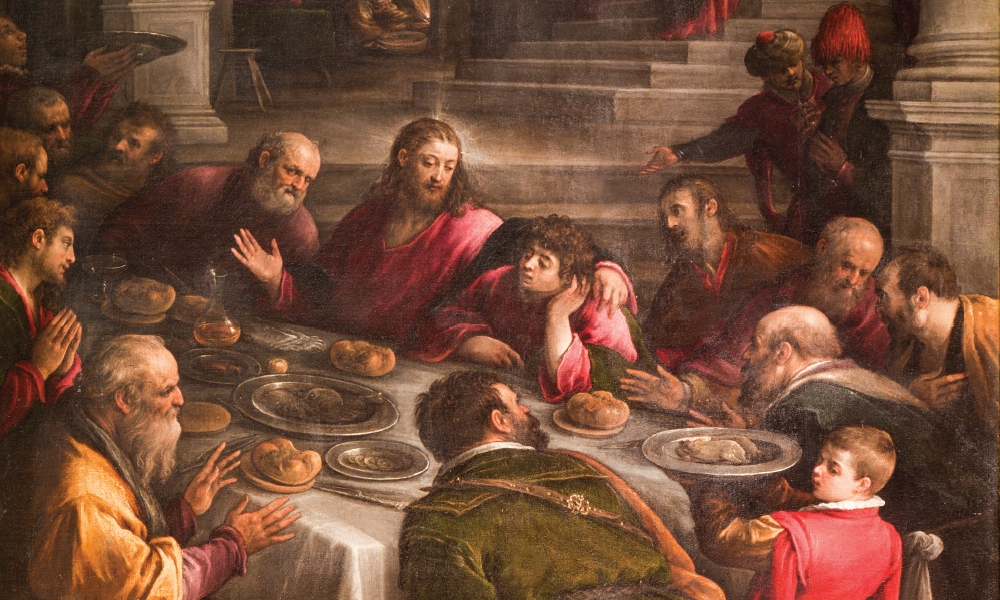
The Church looks to Jesus on the cross to understand how God loves the world. In his passion and resurrection, we encounter a complete and transforming love. Jesus invites us into a new way of life: “As I have loved you, so you also should love one another.” In the Eucharist, the Sacrament of Charity, this love becomes present again, inviting us not only to receive Christ, but to become one with him, to live his life in the world.
To receive the Eucharist means to accept the pattern of Christ’s own life: his self-giving love. The Apostle John speaks of koinonia (fellowship, communion, partnership) through which we enter into communion with the apostolic witnesses, and through them, with the Trinity. (1 Jn 1:3) Communion with God makes us one Church, and that communion commissions us outward into the world, not to imitate its ways, but to transform it with Christ’ love.
Our primary challenge, then, is to work together to build a civilization of love. St. Cyprian taught that the Eucharist is given “for the health and salvation of mankind.” By sharing our humanity, Jesus reveals our true nature, purpose, and highest calling: to be children of God. Benedict XVI wrote that the happiness people seek “has a name and a face: it is Jesus of Nazareth, hidden in the Eucharist.
As Catholics, we engage with the world not from a political program but from an encounter with Jesus Christ. From that encounter flows a coherent social vision: the inviolable dignity of human life from conception to natural death, ordered toward the common good, safeguarded by subsidiarity, animated by solidarity. When these principles are shaped and sustained by the Most Holy Eucharist, the Sacrament of Charity, they become a way of life capable of healing a divided world.