
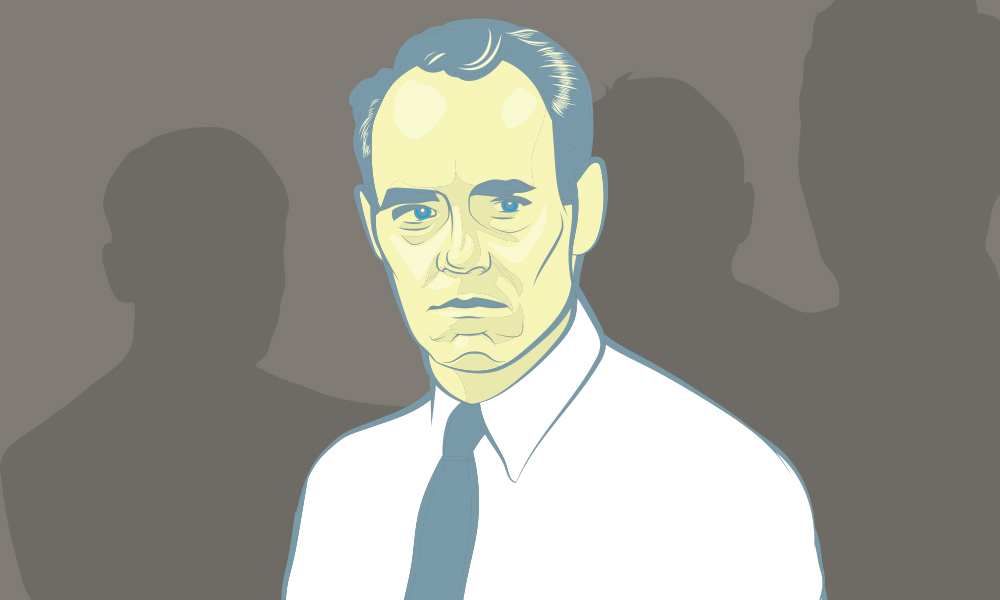
12 Angry Men
“It's always difficult to keep personal prejudice out of a thing like this. And wherever you run into it, prejudice always obscures the truth. I don't really know what the truth is. I don't suppose anybody will ever really know.… But we have a reasonable doubt, and that's something that's very valuable in our system.” —Juror #8
The premise is simple: A jury of 12 men must come to a unanimous decision of either guilty or not guilty in a murder trial. The film begins with them leaving the courtroom floor and isolating themselves in a separate room to discuss the case and reach a verdict. It should be a pretty easy decision; it’s a cut-and-dried case. A wayward teen killed someone. The evidence is straightforward. There are witnesses. This will be a very brief discussion. (It had better be; the room is uncomfortably hot, Juror #10 runs a business and needs to get back to it, and Juror #7 has tickets to the ball game.)
But only 11 of the 12 vote guilty. One man says not guilty. Juror #8 (played by Henry Fonda) stands alone.
And here’s the thing: He’s not even sure the defendant is innocent. He simply isn’t convinced of his guilt beyond a reasonable doubt. The judge explained that if they vote guilty, the sentence in this case is mandatory death penalty. So as long as there is still some doubt in his mind, Juror #8’s conscience forbids him from saying guilty.
The other characters question his uncertainty, and they review the facts from the trial. As the story develops, each character’s own prejudices, biases, assumptions, and fallacious reasoning begin to surface. It becomes an exploration of our own internal weaknesses and human faults. Ethical questions are raised. Moral dilemmas are faced.
“It's not easy to stand alone against the ridicule of others.” —Juror #9
Each character is played so well and so precisely that even though most of the film takes place in a single room with nothing but dialogue and performances to drive the plot, it is one of the most gripping, edge-of-your-seat scripts you’ll hear. In such a cramped setting, blocking (the positioning and movement of the characters) and body language become enormously important. Under Sidney Lumet’s direction, both are masterful.
12 Angry Men is widely acclaimed as one of the best movies ever made. It won the Golden Bear award at the Berlin International Film Festival, and it was nominated for three Academy Awards, including Best Picture (losing to The Bridge on the River Kwai). It holds a perfect 100% score on Rotten Tomatoes, and it has been recognized by AFI and Roger Ebert among the great American films, while remaining near the very top of IMDb’s user-voted Top 250.
This isn’t just a highly acclaimed, technically good movie. It’s genuinely enjoyable to watch. Parents need mainly to be aware of the mature subject matter: murder and patricide, along with themes of racism, ageism, prejudice, and capital punishment. But there is also an opportunity to examine the story’s logical fallacies and ethical questions. We are frighteningly capable of mistaking our own baggage for objective judgment. There is also brief mild language and (unsurprisingly) some very angry men.